


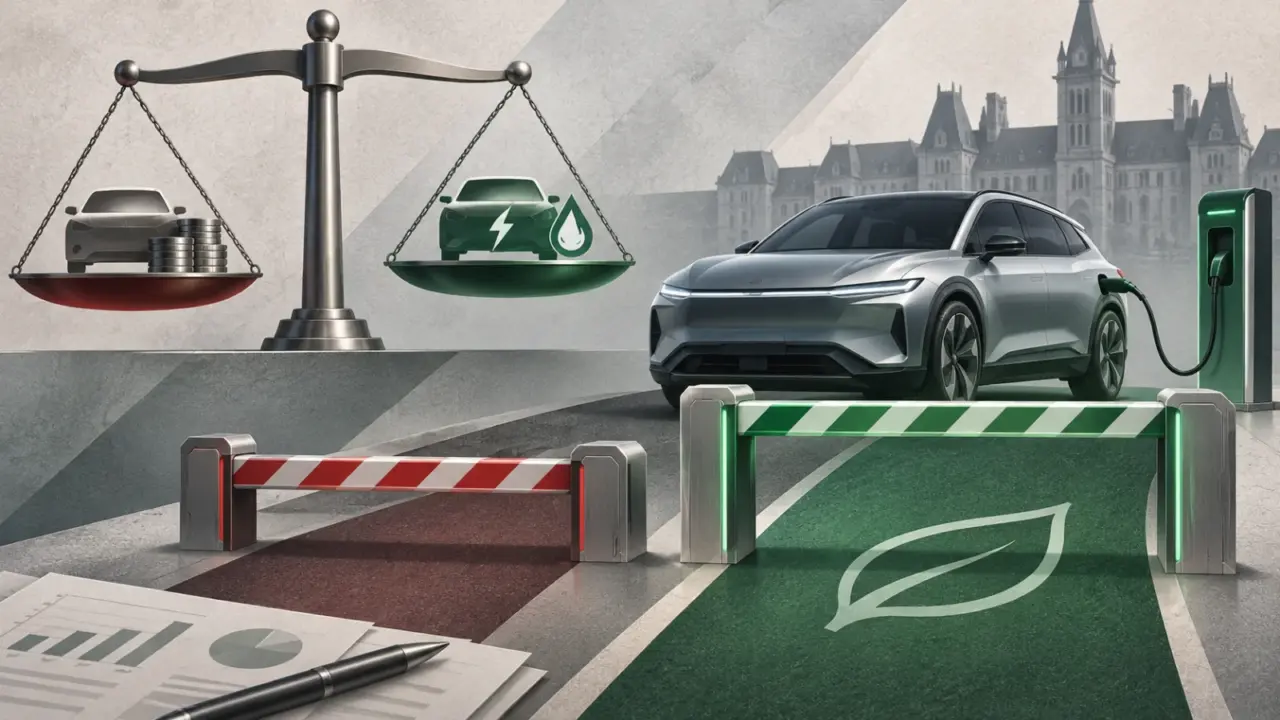
The federal government wants to raise the price threshold at which Canada’s luxury tax applies to fully electric and hydrogen-powered passenger vehicles. The proposal would move that threshold from $100,000 to $150,000 while leaving other vehicles at $100,000.
The Department of Finance announced the change on November 12 and said it was intended to apply from November 13. But the same release says the measure is subject to subsequent parliamentary approval. The distinction is straightforward: the government has published a proposal and draft legislative language, not a completed change to the law.
What the draft legislation says
The draft amendment would create a category called a qualifying electric vehicle. It covers a motor vehicle that is fully electric, fully powered by hydrogen, or otherwise prescribed, except for a vehicle separately prescribed out of the category.
For a qualifying electric vehicle, the taxable-value threshold would become $150,000. For another subject vehicle, it would remain $100,000.
The proposed text is written to be deemed in force on the day after the announcement. It includes rules for sales completed after the announcement date, vehicles imported after that date, vehicles registered after that date, and some lease or ownership situations.
That intended retroactive effect does not remove the need for Parliament to approve the amendment. Buyers, dealers, and importers should rely on enacted law and current Canada Revenue Agency guidance for a specific transaction, rather than treating a news release as tax advice.
How the luxury tax works
Under the current framework described by Finance Canada, the luxury tax on a subject vehicle is generally the lesser of 10 per cent of the vehicle’s full taxable value and 20 per cent of the amount above the applicable threshold.
Raising the threshold would therefore do more than create a flat $50,000 exemption. It would change whether a qualifying vehicle is subject to the tax and, above $150,000, the amount used in the excess-value calculation.
The proposal does not say that every electrified vehicle qualifies. The draft specifically names fully electric and hydrogen-powered vehicles. It does not automatically include conventional hybrids or plug-in hybrids, although the definition allows prescribed vehicles to be added through regulation.
It is also not a purchase rebate. The measure would change the point at which an existing federal tax begins to apply. It would not send a payment to every zero-emission-vehicle buyer.
A separate policy from charging investment
Finance Canada placed the announcement within a wider Budget 2026 electrification package. The department says the budget committed $587 million over five years, starting in 2027–28, to install more than 55,000 chargers through a renewed Zero Emission Vehicle Infrastructure Program. It also proposed $45 million over five years for charging-infrastructure research and development.
Those are separate measures with their own timelines and conditions. A proposed tax threshold does not build charging stations, and a charging program does not make the tax amendment law.
The proposal also sits beside a new public support package for Honda’s Alliston manufacturing operations. That project focuses on next-generation hybrid-electric and gasoline-powered production. It should not be described as a direct beneficiary of a threshold drafted for fully electric and hydrogen-powered vehicles.
What remains to be confirmed
The key next step is parliamentary approval of the draft amendment. Further implementation details may also come through legislation, regulation, or Canada Revenue Agency administration.
For any vehicle near the threshold, the relevant facts could include when a sale is completed, when a vehicle is imported or registered, whether it meets the qualifying-electric-vehicle definition, and which taxable value applies. Improvements, leases, and changes in registered-vendor status can also trigger separate rules under the Act.
The government’s policy direction is clear: it wants more fully electric and hydrogen vehicles priced between $100,000 and $150,000 to fall outside the luxury-tax threshold. The legal status is equally important: until Parliament approves the change, that outcome remains proposed.