


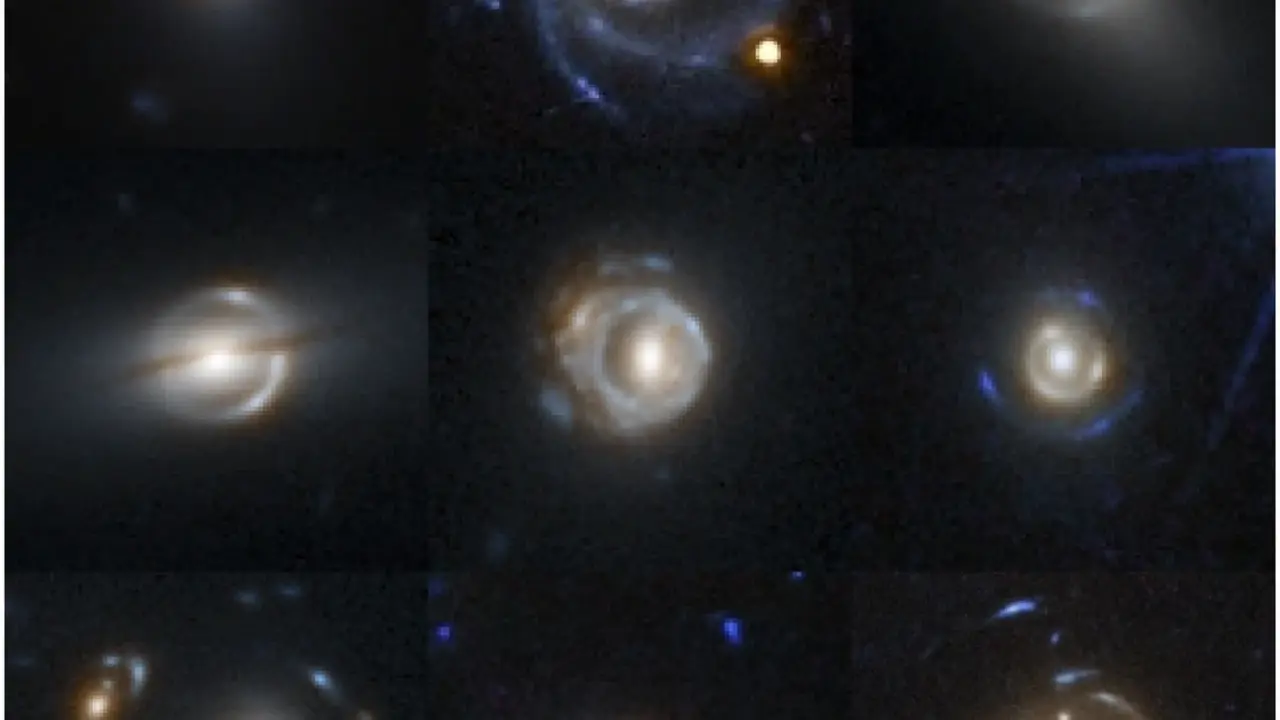
The European Space Agency’s Euclid telescope has produced the largest catalogue yet of strong gravitational-lens candidates, giving Canadian researchers a far bigger and more consistent dataset for studying dark matter and the expansion of the universe.
The catalogue contains 15,072 high-confidence candidates. That number should not be reported as 15,072 confirmed discoveries. The research team classifies 6,073 systems as grade A, or “sure” candidates, and 8,999 as grade B, or “probable” candidates. A further 9,010 grade C “possible” systems sit outside the high-confidence total.
Follow-up observations are still needed to verify individual objects. The catalogue paper was posted to arXiv on November 11 and submitted to Astronomy & Astrophysics; it had not completed journal peer review when released.
The distinction between a candidate and a confirmed lens does not make the result minor. Before Euclid, strong lenses were rare enough that astronomers mostly studied them as individual discoveries. A large sample collected by the same telescope and processed through the same pipeline can support population-level tests that were previously impractical.
Finding rare signals in 900 million sources
A strong gravitational lens appears when the gravity of a foreground galaxy or galaxy cluster bends light from a more distant object. The distortion can create arcs, multiple images, or a nearly complete ring. Because the amount of bending depends on mass—including invisible dark matter—the pattern can help researchers map how that mass is distributed.
The first foundation release for Euclid’s Data Release 1 covers about 2,000 square degrees, roughly 14 per cent of the area planned for the wider survey. It contains close to 900 million sources.
The lens-identification team applied its selection criteria to 68 million of them. Five machine-learning models produced scores, about 7,000 citizen scientists reviewed images, and 67 strong-lensing experts carried out further classification.
That process yielded the grade A and B catalogue. It also identified less common configurations, including 84 candidate double-source-plane lenses and more than 1,000 candidate disc lenses. The paper projects that the full Euclid Wide Survey could contain more than 100,000 high-confidence strong-lens candidates, but that is an extrapolation, not a completed count.
Why the Canadian role matters
More than 30 Canadian researchers contributed to Euclid’s latest release, according to UBC. Canadian organizations involved include UBC, the University of Waterloo, the National Research Council’s Herzberg Astronomy and Astrophysics Research Centre and the Canada-France-Hawaii Telescope.
UBC doctoral researcher Hrishabh Srivastava is among the catalogue paper’s authors. His affiliation appears in the paper alongside the Canadian institutions at Waterloo and the NRC. UBC astronomer Douglas Scott is also part of the Euclid collaboration.
The Canadian contribution is not simply symbolic. Researchers need both a large space-based survey and follow-up capacity to turn candidates into well-characterized systems. Canadian teams can use Euclid data to estimate mass distributions, refine machine-learning methods, and compare systems across cosmic time.
The Canada-France-Hawaii Telescope also provides a connection between a global space mission and ground-based observing expertise. Still, the release does not assign every candidate to a Canadian-led follow-up program, and it would be premature to claim that the catalogue has already delivered a specific dark-matter measurement by a Canadian team.
What the lenses can—and cannot—show
Strong lensing is valuable because it responds to total mass, not only the stars and gas that emit light. By modelling the geometry of a lens and the distorted background image, astronomers can infer the mass profile of the foreground system.
Across thousands of systems, those measurements could test how dark-matter haloes vary between galaxies and over time. Lensed quasars can also help measure cosmic expansion because multiple images of a changing source arrive on different schedules.
But a photograph of an arc does not directly reveal what dark matter is made of. Nor does the new catalogue settle the nature of dark energy. It supplies a much larger set of targets that researchers can model and observe, reducing the statistical limitations of earlier, smaller samples.
The release is also a reminder that machine learning did not operate alone. Algorithms narrowed a vast search, while volunteers and experts examined the results. Final confirmation will require additional data. That combination makes the catalogue a useful example of AI-assisted science with explicit human review rather than an autonomous discovery system.
A foundation release, not the finished mission
Euclid’s November release spans roughly 13 months of observations. ESA says it includes more than 900 million galaxies, more than 60 million quasar candidates, and spectra from more than 160 million sources, alongside the lens catalogue.
Those figures describe a foundation data release from an ongoing mission. The remainder of Data Release 1 is expected later, and Euclid’s six-year survey is designed to map more than one-third of the sky.
For Canadian astronomy, the immediate opportunity is the scale and consistency of the new material. The catalogue turns a field built around rare objects into one with thousands of comparable candidates. The next stage—confirmation, modelling, and interpretation—will determine which of those candidates become reliable tools for measuring the dark universe.
More space and research reporting is available in The North Scope’s Technology & Science section.
Sources: European Space Agency; Euclid Collaboration catalogue paper; UBC Science.