


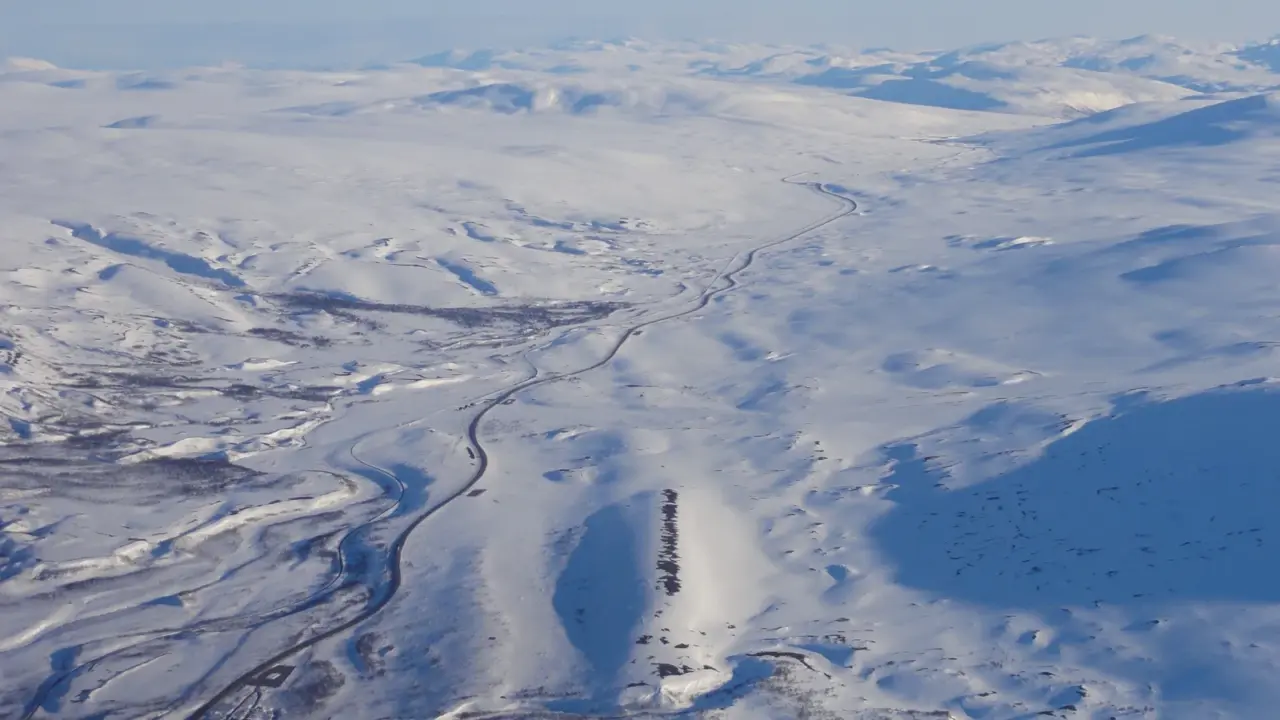
Two major increases in the thickness of Earth’s mountain belts may have changed the supply of nutrients and oxygen in ways that helped complex life develop, according to a new study led by University of British Columbia researchers.
The work, published in the peer-reviewed journal Science Advances on November 13, reconstructs more than three billion years of mountain-building history. Its central finding is geological: the maximum thickness of crust beneath mountain belts appears to have increased in two broad pulses, one between about 2.7 billion and 2.2 billion years ago and another between about 800 million and 700 million years ago.
The proposed biological consequence is more tentative. The researchers argue that taller mountains could have accelerated weathering and erosion, carrying nutrients into the oceans and creating conditions that supported photosynthesis, oxygenation, and greater biological complexity. The timing is suggestive, but it does not by itself prove that mountain growth caused those changes.
That distinction is important because the study joins several incomplete records—from deeply buried rocks, ancient ocean chemistry, and the history of life—across immense spans of time.
Reading pressure as a record of lost mountains
Mountain ranges do not survive intact for billions of years. They erode, their rocks are recycled, and plate tectonics rearranges the crust. The researchers therefore did not measure ancient peaks directly.
Instead, they compiled pressure estimates preserved in metamorphic rocks. Such rocks record the conditions they experienced when buried deep in the crust during mountain-building events. Greater pressure generally indicates greater burial depth, which can be used to estimate how thick the crust in an ancient mountain belt became.
The analysis suggests that the maximum mountain-belt crust thickened by roughly 30 kilometres during each of the two pulses. UBC summarizes the progression as an increase from about 30 kilometres to 60 kilometres around the first pulse, followed by a rise toward 90 kilometres around the second.
For comparison, the crust beneath the modern Himalaya can reach about 80 kilometres in thickness. That does not mean researchers have identified a specific three-billion-year-old equivalent of Mount Everest. The result concerns the maximum crustal thickness that mountain systems could support, not a catalogue of individual ancient summits.
The team includes researchers from UBC, Utrecht University, Université Laval, the Swedish Museum of Natural History, and the Geological Survey of Canada. Lead author Matthijs Smit is a professor in UBC’s Department of Earth, Ocean, and Atmospheric Sciences.
Why taller mountains could change the surface
As rocks rise above sea level, rain, temperature changes, and chemical reactions break them down. Rivers then carry dissolved material and sediment toward the oceans. That process can deliver phosphorus and other nutrients that support marine productivity.
More biological productivity can influence atmospheric oxygen over long periods. Weathering also participates in the carbon cycle, although the strength and direction of those effects depend on the rock type, climate, relief, and other conditions.
The two mountain-growth intervals broadly overlap with major changes in nutrient fluxes, biological sulphur metabolism, and surface oxygenation. The first coincides with the era of the Great Oxidation Event. The later pulse falls near another long-term increase in oxygen before the diversification of complex animals.
The paper proposes a chain linking Earth’s slow internal cooling to changes in tectonic behaviour, then to thicker mountain belts, stronger weathering, and a more nutrient-rich surface environment. It is a plausible mechanism that connects the solid Earth with the biosphere, not a direct observation of each link happening in sequence.
Where the uncertainty sits
The geological record is discontinuous. Rocks that would fill gaps may have been eroded, altered, or returned to the mantle. Reconstructing the depth of the ancient boundary between crust and mantle is also difficult, and estimates of past elevation depend on assumptions about crustal density and sea level.
The authors acknowledge those constraints. The evidence is strongest for step-like changes in the pressure record and therefore the depth to which rocks were buried. The link from greater crustal thickness to higher average mountain elevation is inferred from geophysics. The link from taller mountains to the evolution of complex life is a mechanistic hypothesis supported by timing and established weathering processes.
It would therefore be too strong to say the study proves mountains created complex life. Other forces—including ocean chemistry, climate, volcanic activity, and biological innovation—also shaped habitability over the same periods.
The study was available as a Research Square preprint in March. That preliminary version explicitly had not undergone peer review. The final paper is now published in Science Advances, so it should not be described as a preprint, though peer review does not remove the study’s stated uncertainties.
A Canadian contribution to a very long timeline
The research gives Canadian institutions a prominent role in a broad Earth-system question. UBC led the study; Université Laval and the Geological Survey of Canada are also represented among the authors.
Its value is not a simple origin story for life. It is a testable framework for asking how changes deep inside the planet may have altered the surface environment. Better records of ancient crustal thickness, weathering, and nutrient cycling will be needed to determine how much of the apparent connection is causal.
For now, the evidence supports a careful conclusion: Earth’s mountain belts became capable of growing substantially thicker in two pulses, and those changes may have helped make the planet more hospitable to complex life. “May have” remains essential.
More Canadian research coverage is available in The North Scope’s Technology & Science section.
Sources: Science Advances; UBC Science; UBC Earth, Ocean and Atmospheric Sciences; Research Square preprint.