


The federal government says it will invest $200 million in the Woodfibre LNG project near Squamish, British Columbia, to raise the export facility’s planned capacity. What Ottawa has not yet made public is the financial structure of that support or the conditions attached to it.
Natural Resources Canada announced the investment on November 13. The department said the money would help lift Woodfibre’s annual production target from 2.1 million tonnes of liquefied natural gas to between 2.5 million and 2.6 million tonnes. That is an increase of 19 to 24 per cent. The same announcement said the investment would allow the company to explore a possible second phase.
The release calls the support an “investment,” but does not say whether it is a grant, loan, equity stake, tax measure, or another instrument. It also does not identify a payment schedule, eligible costs, milestones, repayment terms, or public return. Those details remain unknown based on the published material.
That distinction matters. A capacity target is not the same as completed capacity, and money announced for a project is not evidence that an expansion has been built. Woodfibre LNG remains under construction, with operations expected in late 2027. The federal release describes that date as an expectation, not a guarantee.
What the project is intended to do
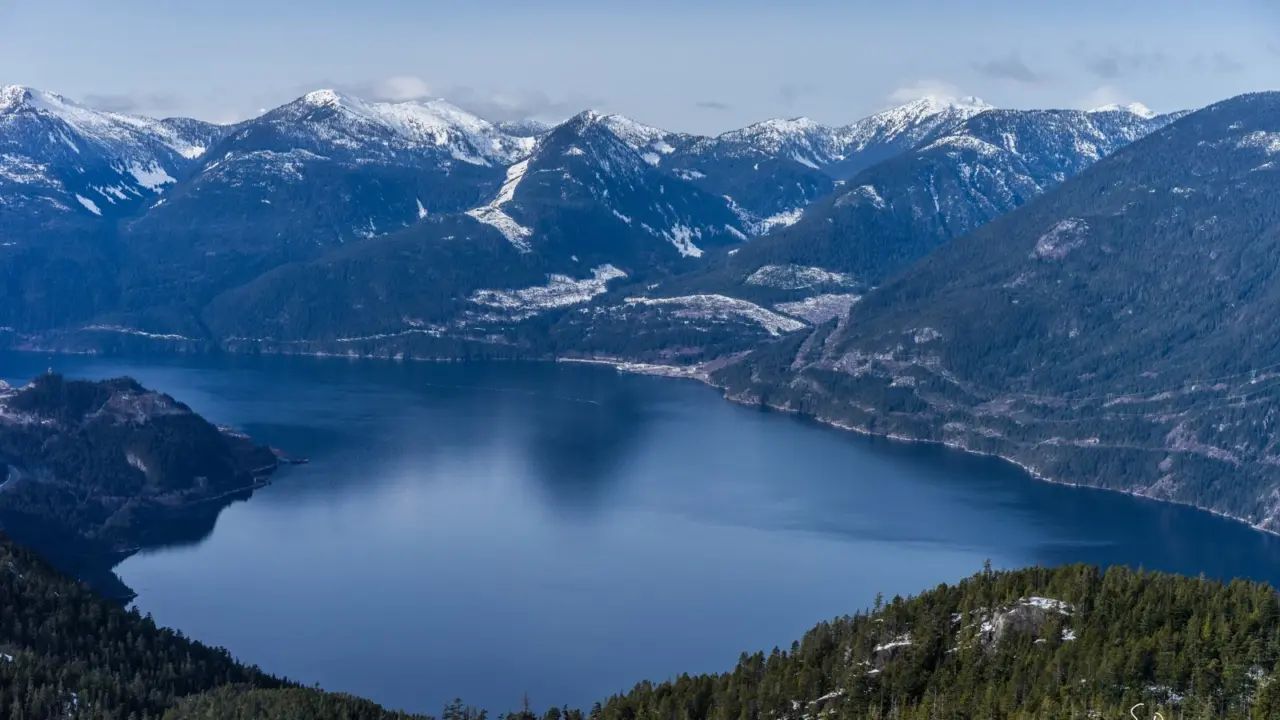
Woodfibre LNG is being built at Swiy̓át, a former Squamish Nation village site that later became the Woodfibre pulp-and-paper mill. The site sits on the west side of Nexwnéwu7ts Átlḵ’a7tsem, or Howe Sound, roughly seven kilometres southwest of Squamish.
The facility is designed to liquefy natural gas delivered through FortisBC’s Eagle Mountain pipeline and load it onto ships for export. The Squamish Nation says two to three LNG carriers are expected each month once the project is operating.
The federal government says about 1,500 people work on the site each day during construction and that the operating facility is expected to support 100 full-time jobs. Those are government and project figures; they are not an independent count by The North Scope.
Canada approved a 40-year export licence for the project in 2017. The B.C. Energy Regulator lists a permitted capacity of approximately 2.1 million tonnes a year, which is the project’s existing design level. Ottawa’s new announcement describes a higher target, but it does not say which regulatory approvals or permit amendments would be required to reach it.
Indigenous oversight is part of the project’s legal structure
The project’s governance is unusual in Canada. The Squamish Nation conducted its own environmental assessment between 2013 and 2015 and approved Woodfibre LNG subject to legally binding conditions.
The Nation says those agreements give it a regulatory role through the project’s planning, construction, operation, and closure. Its oversight has led to design changes and continuing monitoring. The federal release describes 25 legally binding conditions across the Woodfibre LNG and associated pipeline agreements.
This is more than consultation language. The Nation’s Rights and Title Department monitors commitments, and Indigenous monitors are present during construction. Still, the existence of that framework does not resolve separate questions about the federal investment’s financial terms, which were not included in the announcement.
The emissions claim needs careful reading
Ottawa and Woodfibre present the project as a comparatively low-emissions LNG facility because its compression and liquefaction equipment will run on B.C. hydroelectricity rather than conventional gas-driven turbines.
Natural Resources Canada says Woodfibre expects an emissions intensity roughly nine times lower than the global average for LNG export facilities. The department also repeats a company comparison equating the difference with the annual emissions of about 140,000 cars.
Those figures are projections supplied by the project, not measurements from an operating plant. They concern the emissions intensity of the export facility, not the full life-cycle emissions from producing, transporting, and ultimately burning the gas.
The “net-zero” label also depends partly on offsets. The federal release says Woodfibre is buying local, nature-based carbon credits for residual emissions from construction and future operations. That means the claim is not that the facility will produce no greenhouse-gas emissions. It is a claim that remaining emissions will be balanced through purchased credits.
Canada is also promoting methane-control technology through programs such as AVOID-Methane, but a technology program and an LNG-facility emissions projection answer different questions. Neither establishes the complete climate effect of exported gas.
What remains to be disclosed
The announcement establishes a federal commitment of $200 million and a planned increase in Woodfibre’s production target. It does not establish the investment instrument, disbursement conditions, public upside, required approvals, or final construction cost.
Those details will determine how much financial risk taxpayers carry and what the government receives in return. Until Ottawa publishes an agreement, contribution document, or other terms, the safest description is straightforward: Canada has announced $200 million for a larger Woodfibre LNG target, while the mechanics and safeguards of that support remain undisclosed.
Sources: Natural Resources Canada; Squamish Nation; B.C. Energy Regulator.